
Suno: When Content Creation and Recommendation Systems Merge

Don't have content you like right now? No worries, give me a second, and I'll create it for you. — The next generation personalization system
The Fusion of Technology and Art
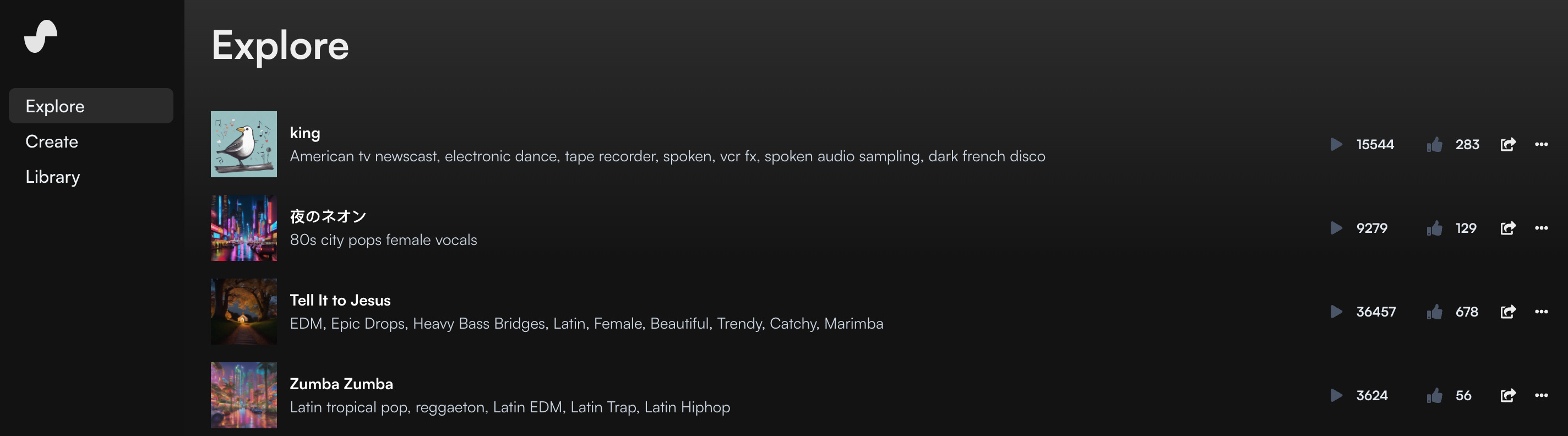
I recently stumbled upon a fascinating website called Suno (https://app.suno.ai/) that can generate songs based on your specifications. While some may find this feature familiar, for many, it remains an astonishing new discovery. Suno's capability to produce music across genres - from rock to jazz, from Jamaican Reggae, to Chinese ballads, to English electronic - exceeded my expectations.
Back in December last year, a tool I was developing called "Taotie" had already uncovered an open-source project named Bark. At the time, I merely skimmed through its GitHub page without delving deeper. However, compared to OpenAI's Whisper, Bark's ability to generate voices with authentic accents and tones made a lasting impression on me. It is this technology that forms the heart of Suno.
Synthesized voices with a very real inflection
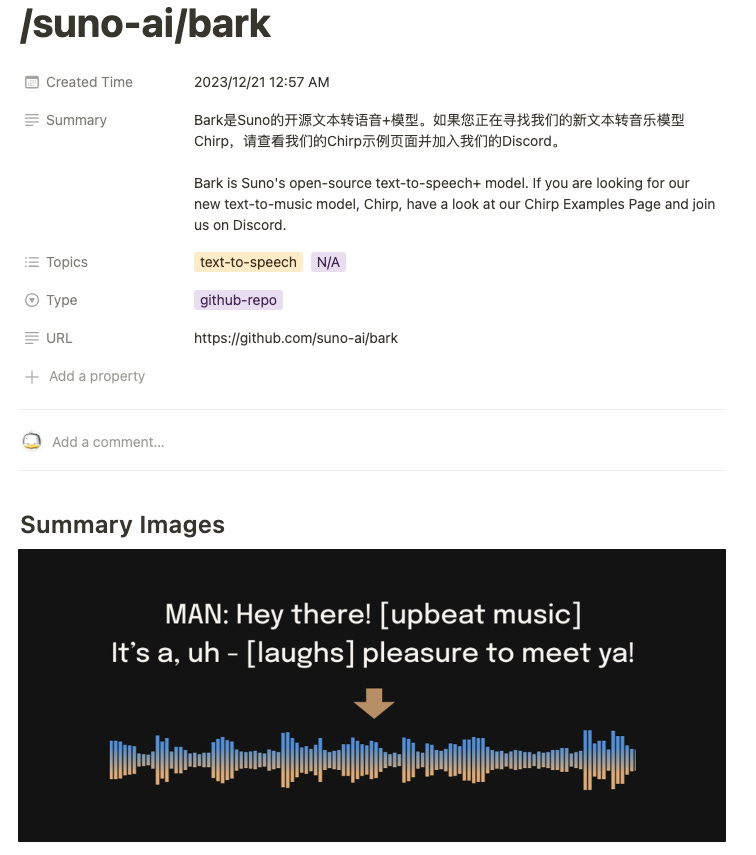
Bark is merely an algorithm, but Suno has transformed it into a complete music creation product. I personally tested the platform and produced two songs. The first, "Echoes of Mind", is an English rap on the same theme. And the second, "The Song of the Thinker" is a Chinese rap adapted from the description of my public blog. These two pieces not only demonstrate Suno's ability to create high-quality music from simple descriptions but also showcase how technology and art can merge seamlessly, opening up new possibilities.
Echoes of Mind
The Song of the Thinker
If you like the music, please subscribe this blog for free :)
The Future Landscape of Content Platforms: From Half-AI to Full-AI Driven
Observing the current content platforms, each one stands out as a successful business model. Be it Instagram, TikTok, YouTube, Xiaohongshu, or Bilibili, their success stories are all centered around the interaction between users and content creators. In this interactive ecosystem, the role of AI has become increasingly significant. In fact, the search and recommendation systems (S&D) on the user end might be one of AI's most successful commercial applications, where an efficient S&D system can bring in billions in revenue for a company. This is a half-AI (user side) solution.
However, on the creator end, AI's adoption seems to lag. From 2020 to 2022, despite witnessing an increase in AI-generated content—from Will Smith's amusing spaghetti meal to Dwayne Johnson's rock feast—these captivating pieces have yet to form a cohesive system.
2023 marks the beginning of a new chapter, with major platforms launching official tools to directly assist content creators in producing new content. However, I believe that products driven purely by AIGC represent a brand new domain that would be hard to merely evolve from existing products. This fundamental transformation might shake the foundation of the creator community, involving complex human relationships and creative ecosystems. It could even spark a new form of Luddism. Therefore, rather than painfully reforming the existing model, creating a brand new platform might have a better chance of success.
The emergence of Suno exemplifies this fresh approach. On this new music platform, the barrier to creation isn't professional musical equipment or superb musical skills but your creativity. The platform provides the tool support; all you need to do is turn your creativity into reality, and the rest is up to the platform to push your work to potential fans.
In this era of information explosion, the amount of contents on even traditional platforms is staggering. Any given platform can have content numbering in the hundreds of millions, while the scale of content handled by products like Meta's news feed and Google search is in the trillions.
Fishing out content that interests users from this vast ocean is as hard as finding a needle from the haystack. Everyone has their preferences, and the role of the S&D system is to tailor recommendations based on the platform's understanding of its users. For instance, if you like Rap, the system will push new songs by Eminem your way; if you're into reggae, you'll get recommendations for legendary Jamaican singer Bob Marley.
As technology continues to advance, generating content becomes easier, necessitating future recommendation systems to push more precise content more efficiently. The explosive growth of content places higher demands on the efficiency and scale of the S&D systems. For technology providers, this represents not only a challenge but also an opportunity—perhaps, especially for companies like Nvidia, it's exactly what they've been anticipating.
The Evolution of Recommendation and Search Systems: Scaling Law also Applies
During Nvidia's Q4 2023 earnings call, CEO Jensen Huang remarked that recommendation systems are currently the largest single software systems on the planet. This statement deeply resonated with me.
In terms of systems, Meta's news feed recommendation system required tens of thousands of servers for support even since a decade ago, while it's said that Google's search infrastructure relies on millions of servers.
From a modeling perspective, in 2016, Meta developed an internal inference system called Sigrid, a distributed inference system. Its debut allowed recommendation models to break free from the limitations of a single machine and enabled them to be deployed across multiple machines. At that time, we were already discussing models with billions of parameters. Of course, most of those parameters were for the embedding's lookup tables by then. Before Sigrid's introduction, we had to go to great lengths to keep the models small enough to fit on a single machine. For instance, during my internship, the project I worked on involved training millions of small, personalized models for the most active users on News Feed to achieve personalization. Due to the generally low capacity of models at that time, achieving true personalization was quite challenging.
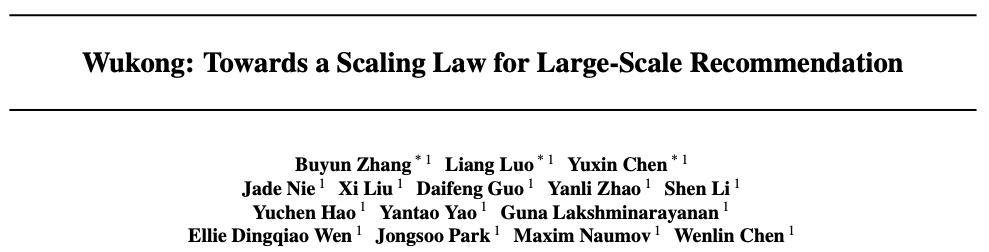
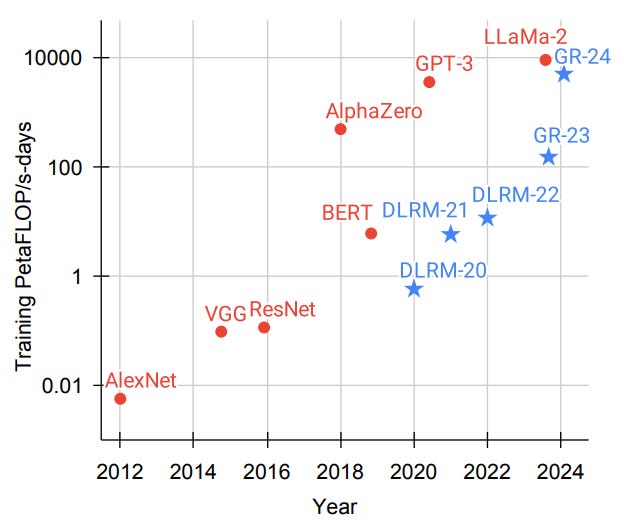
Just in these past two months, Meta published two papers, introducing recommendation system models with trillion parameters, further proving that the scaling law continues to hold true for recommendation systems. Now, the scale of recommendation system models is on par with that of GPT-4.

Creators Left Behind? No, Everyone Becomes a Creator
In the world of search and recommendation systems, Candidate Generation plays a crucial role. Its task is to sift through the vast ocean of contents to find the pieces that might attract users. However, this so-called "generation" is actually a process of "selection".
The emergence of the Suno platform not only showcases the maturity of content generation technology but also signals the future integration of content platforms with search and recommendation systems. In this trend, content generation is not just about providing tools for creation; it's about closely integrating with the recommendation system to offer truly personalized content services. As technology continues to evolve, future content platforms will be able to better understand user needs, instantly generate, and recommend high-quality, highly personalized content, offering an unprecedented experience to users.
The progress in AIGC has sparked a wild idea in my mind. The search and recommendation systems of the future might merge with content generation systems. Imagine, at the moment you visit a short video platform, the system could instantly generate a video completely customized to your preferences.
If current systems achieve personalization by matching existing content, future systems might offer true, end-to-end personalization—don't have content you like right now? No worries, give me a second, and I'll create it for you.
What could be the basis for generation? It could be explicit inputs from users, or prompts automatically generated based on user profiles.
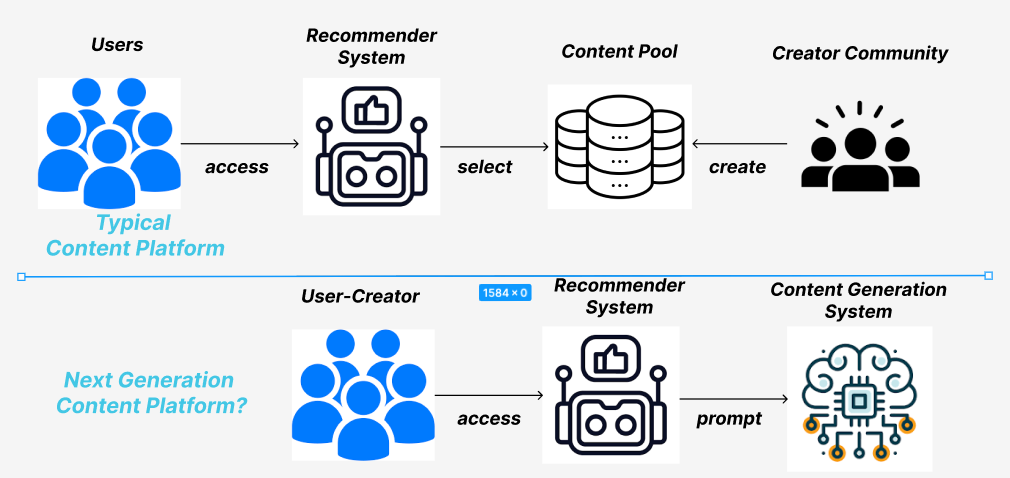
In this future, the term "Candidate Generation" will truly live up to its name, not just selecting from existing content but creating content on the spot based on users' unique preferences. This future, while filled with challenges, is also incredibly exciting.